Fine-needle aspiration (FNA) biopsy of the thyroid is a minimally invasive, in-office procedure used to evaluate thyroid nodules for cancer. Our endocrinologists perform ultrasound-guided thyroid FNA at our Houston clinics, with results typically classified using the Bethesda System within 3–5 business days.
Thyroid Nodule Evaluation
Thyroid nodules are extremely common — detected in up to 65% of adults on ultrasound. The vast majority are benign, but a small percentage can be malignant. The key is proper evaluation to identify which nodules need further workup and which can be monitored.
Our endocrinologists use thyroid ultrasound to evaluate nodule size, composition, and characteristics according to current guidelines (ACR TI-RADS and ATA). When a biopsy is indicated, we perform ultrasound-guided FNA in our office — a quick, minimally invasive procedure that provides a tissue diagnosis.
FNA biopsy is the gold standard for evaluating thyroid nodules at risk for malignancy. Using real-time ultrasound guidance, a thin needle is passed into the nodule to collect cells for cytological analysis. Results are typically available within 5–7 business days.
For patients with thyroid cancer, we coordinate care with head and neck surgery and nuclear medicine, and we provide ongoing surveillance after treatment.
When Is a Thyroid Biopsy Needed?
Nodule Size
Nodules over a certain size threshold — particularly those with suspicious features — are evaluated for biopsy per ATA and TI-RADS guidelines.
Suspicious Ultrasound Features
Irregular borders, microcalcifications, solid hypoechoic composition, or taller-than-wide shape increase the likelihood of malignancy.
Nodule Growth
A nodule that has significantly grown on serial ultrasound — even if it was previously considered low-risk — may warrant biopsy.
Family History of Thyroid Cancer
Patients with a family history of medullary thyroid cancer or MEN syndrome require more aggressive evaluation.
Radiation History
Prior head/neck radiation significantly increases thyroid cancer risk and lowers the threshold for biopsy.
Symptoms
Hoarseness, dysphagia, or rapid nodule growth may indicate local invasion and prompt expedited evaluation.
What to Expect During an FNA Biopsy
Preparation
No special preparation is needed. You may eat and drink normally. If you take blood thinners (aspirin, warfarin, etc.), let us know in advance — we may ask you to hold them briefly.
Ultrasound Positioning
You will lie on an exam table with your neck slightly extended. The neck is cleaned with antiseptic, and ultrasound gel is applied to visualize the nodule in real time.
Needle Pass
A thin needle is guided into the nodule under ultrasound visualization. Most patients feel minimal discomfort. The pass takes only a few seconds, and 2–3 passes are typically performed to ensure adequate sampling.
After the Procedure
Light pressure is applied for a few minutes. You can return to normal activities immediately. Mild soreness at the site for 1–2 days is normal. Results are typically reported within 5–7 business days.
Frequently Asked Questions
Is an FNA biopsy painful?
Most patients tolerate FNA biopsy very well. The discomfort is similar to a blood draw. Topical numbing cream can be applied before the procedure if requested. Local anesthesia is not routinely needed but can be used.
What do FNA results mean?
Results are reported using the Bethesda classification system (I–VI), ranging from non-diagnostic to malignant. We discuss results with you directly and explain what next steps, if any, are recommended based on the category.
What if my biopsy is benign?
Benign (Bethesda II) results are reassuring. We typically recommend repeat ultrasound in 1–2 years to ensure the nodule remains stable. Further biopsy is usually not needed unless the nodule grows significantly.
Do I need a referral for a thyroid ultrasound or FNA?
A referral is not required for most commercial insurance plans, though HMO patients should verify with their primary care provider. We will handle prior authorization for the procedure.
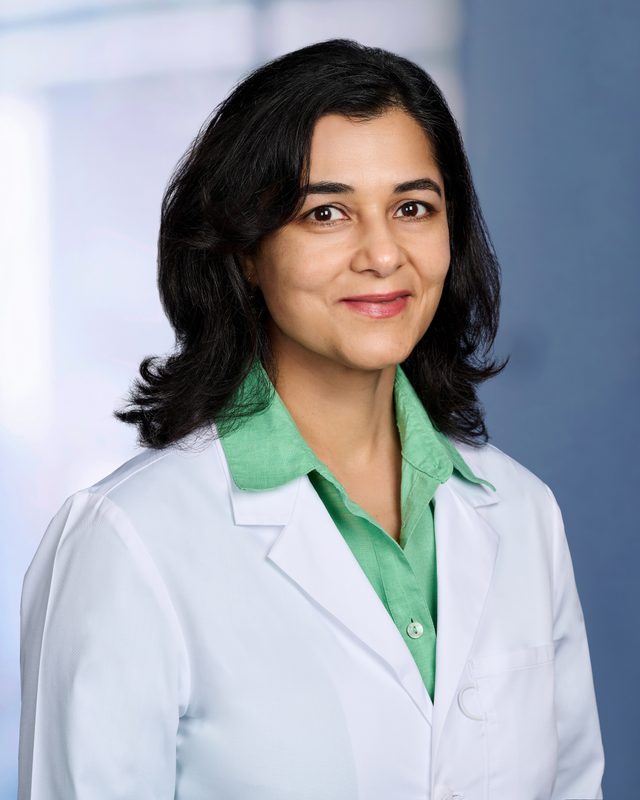
Dr. Chadha has a special focus on thyroid nodules and thyroid cancer. Our earliest new-patient appointments are with Dr. Chadha, in Sugar Land and Memorial City. She speaks English, Hindi and Punjabi.